
Josh.ai’s Code of Conduct for AI in the Home: Who Is in Charge Here?

On September 23, Josh.ai published something we haven’t seen from any other smart home company: a written Code of Conduct for AI in the Home — twelve rules for how an artificial intelligence is allowed to behave inside a house, and a permissions structure to enforce them. We install Josh.ai in luxury homes across the Wasatch Back, so here is what the code says, and what it looks like when we program it into a real house.
Rules of the road for AI in the home

Josh.ai’s CEO, Alex Capecelatro, puts the whole document in one line: “Who is in charge here? The answer, in every case, needs to be the homeowner.” That sounds obvious until you think about what an AI with access to your locks, garage, cameras, shades, thermostat and lighting could do on a misunderstood request, a bad inference or a compromised account. A voice assistant that plays the wrong song is annoying. One that unlocks the wrong door is a different category.
The code translates the broad AI-safety conversation into the specific context of a home. Here are the twelve rules, and what each means when you live with it:
- Humans remain in control. Anyone authorized can interrupt, redirect or stop whatever the AI is doing, instantly.
- The AI acts only with authority. Every physical action traces back to something a person asked for or set up.
- Consequence determines confirmation. Dimming a lamp needs no confirmation. Unlocking the front door at 2 a.m. does.
- Off means off. An obvious, low-friction way to disable the AI entirely.
- Behavior is predictable and bounded. Requests are checked against permissions before anything moves.
- Actions are explainable and auditable. You can see what it did, why, and on whose authority.
- Actions are reversible or safely contained. Undo is easy; irreversible actions require stronger confirmation.
- Privacy is the default. Minimal data, and only what is necessary leaves the house.
- Security is the default. Built in, not left to the owner or installer as optional hardening.
- Local first, resilient by design. Core control prefers local paths; the house keeps working when the internet or the cloud AI is down.
- Access is limited, and nothing can grant itself more. Every app, device and service gets only what it needs, for as long as it needs it.
- Uncertainty reduces autonomy. When the system isn’t sure about intent, identity or consequence, it does less, not more.
Intelligence answers to the control system

The part that matters most to us as installers is the separation between intelligence and authority. In Josh.ai’s architecture the AI never operates a device directly. It interprets what you want and proposes an action; the control system checks that request against the household’s permissions, the risk and the scope; and only what was allowed is carried out, locally wherever it can be.

That is also the answer to the “where does my data go” question. Fast, private, always-available control lives on hardware in your home and works offline. Large-model reasoning happens in the cloud only when it adds something, and only with what is needed. You draw the line.
The Home Authority Stack
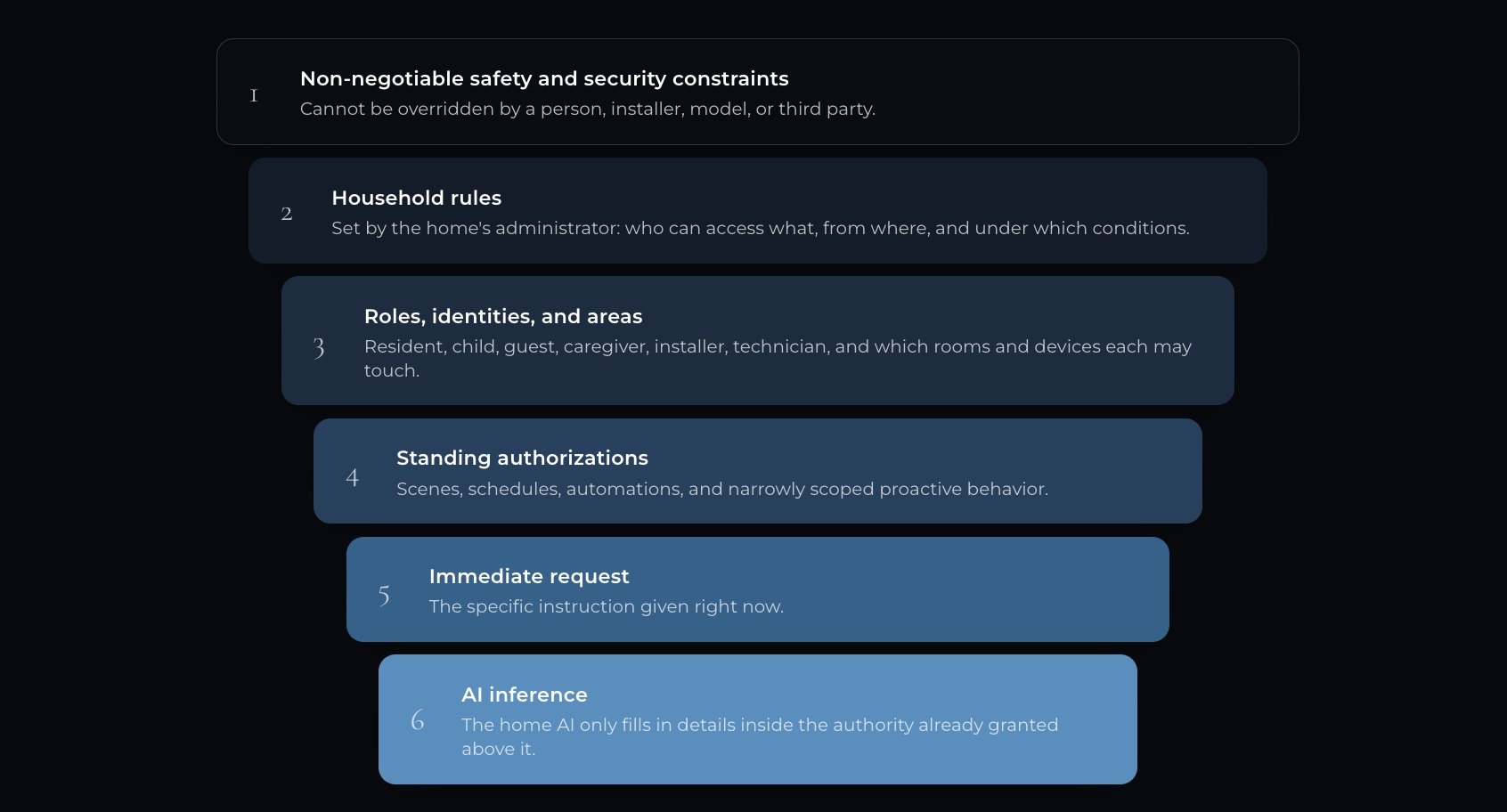
The rules are principles. This is the mechanism. Non-negotiable safety and security constraints sit at the top and cannot be overridden by anyone — not the owner, not us, not the model. Below that: the household’s own rules; roles and identities (resident, child, guest, caregiver, technician) and which rooms and devices each can touch; standing automations like scenes and schedules; the immediate request; and finally the AI’s inference, filling in details only within authority already granted above it.
In practice, on a Josh.ai system we program, that is why the kids’ voice profile can run the movie scene but cannot disarm the alarm, why the house sitter controls lights in the guest wing and nothing else, and why a cloud outage leaves the touchscreens and keypads working. None of that is a Josh.ai-only idea — it is how we set up every home automation system. What is new is a manufacturer writing it down and committing to it.
Preparing for a more capable future

The code also takes on the worry that AI will one day improve past meaningful oversight. Josh.ai’s position is that the answer isn’t a smarter AI that promises to behave; it is a control system that physically cannot be talked past. Rule twelve is the practical version: when the system is unsure about intent, identity or consequence, it does less. In a house, “doing less” is the safe default every time.
An invitation to the industry

Josh.ai is publishing this as an open, voluntary standard and inviting platform makers, device manufacturers and integrators to adopt it. For homeowners, it is a commitment that the intelligence entering the house stays helpful, private and under their control. For installers like us, it is a checklist we can be held to.
What this looks like in a Utah home

We get asked why we don’t just wire the house to Alexa or Google. Consumer assistants are built to sell you things and learn from you; Josh.ai is built to run your house and answer only to you. The processing that matters happens on hardware in your home, the microphones have physical mute, and now there is a published standard you can hold them to. Pair it with a real control platform — Control4, Crestron, Lutron — and voice becomes one more way to run the house.
Our own rule, before the code existed: anything that opens, unlocks or disarms is never voice-only in a home we program. It takes a confirmation, a PIN or a keypad press. Josh.ai’s rule three now says the same thing.
See how we design a Josh.ai home →
Shield Low Voltage is a Josh.ai dealer serving Park City, Heber, Alpine, Highland, Draper, Holladay and Salt Lake City. Source: Josh.ai Stories; read the full code at josh.ai/ai.